Sintering is a process that transforms powdered materials into a dense body, and it is a crucial step in cemented carbide production. Cemented carbide sintering is typically carried out at high temperatures of 1400°C to 1600°C, during which the material undergoes liquid phase formation, particle rearrangement, and densification. One of the fundamental causes of deformation is non-uniform shrinkage, which may be caused by the following:
1. Uneven density distribution during the pressing process can lead to inconsistent shrinkage during sintering, resulting in deformation. For example, areas with lower density shrink more severely, potentially causing blistering or concavity.
2. Abnormal carbon content. Localized carbon deficiency reduces the liquid phase, leading to uneven shrinkage and increasing the likelihood of blistering or cracking. A carbon gradient refers to uneven carbon atmosphere or temperature differences within the sintering furnace, which can create a carbon content gradient and exacerbate deformation.
3. Temperature and atmosphere control. Excessive heating rate may cause the liquid phase to seal gas channels, forming pores or bubbles. Uneven cooling rate (e.g., temperature difference > 50°C across the furnace) will cause a shrinkage mismatch between the hard phase WC (thermal expansion coefficient 5.5 × 10⁻⁶/K) and the Co phase (13 × 10⁻⁶/K), leading to bending deformation. In a vacuum or hydrogen atmosphere, the carbon-oxygen reaction may affect the uniformity of carbon content.
4. Improper boat loading or uneven backing plates. Improper boat loading or uneven backing plates will lead to uneven stress on the sintered body, causing localized stress concentration and deformation.
So how can we avoid deformation? Generally, we start from the following aspects:
1. Raw material and compact control: Use high-purity WC powder and add 0.3%-0.5% VC inhibitor. The compact density should be uniform to reduce shrinkage difference to <1%.
2. Sintering curve design: Stepped heating (e.g., 5°C/min before 800°C, then 2°C/min) combined with isothermal holding (1400°C ± 10°C, 60 min) can reduce thermal stress by more than 30%.
3. Mold compensation technology: Pre-deforming the mold based on shrinkage simulation results (e.g., reverse pre-bending 0.2°-0.5°) can offset 90% of sintering warpage.
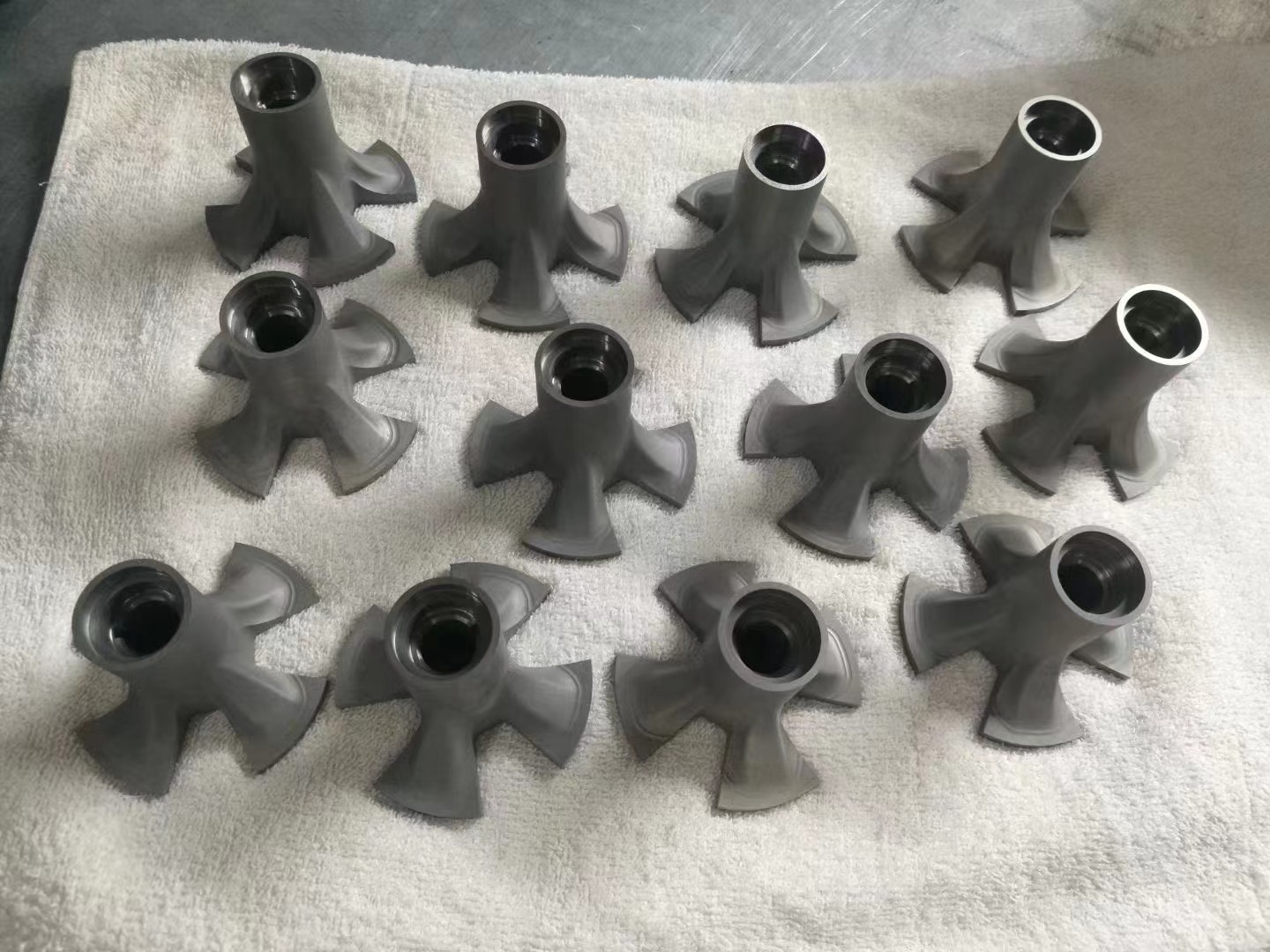
4. For non-standard products with special shapes, a dedicated sintering boat with anti-stick coating must be used to reduce stress concentration during sintering.
OSTON CARBIDE is committed to providing customers with cost-effective cemented carbide wear-resistant solutions,your inquiry or questions are more than welcome here.


