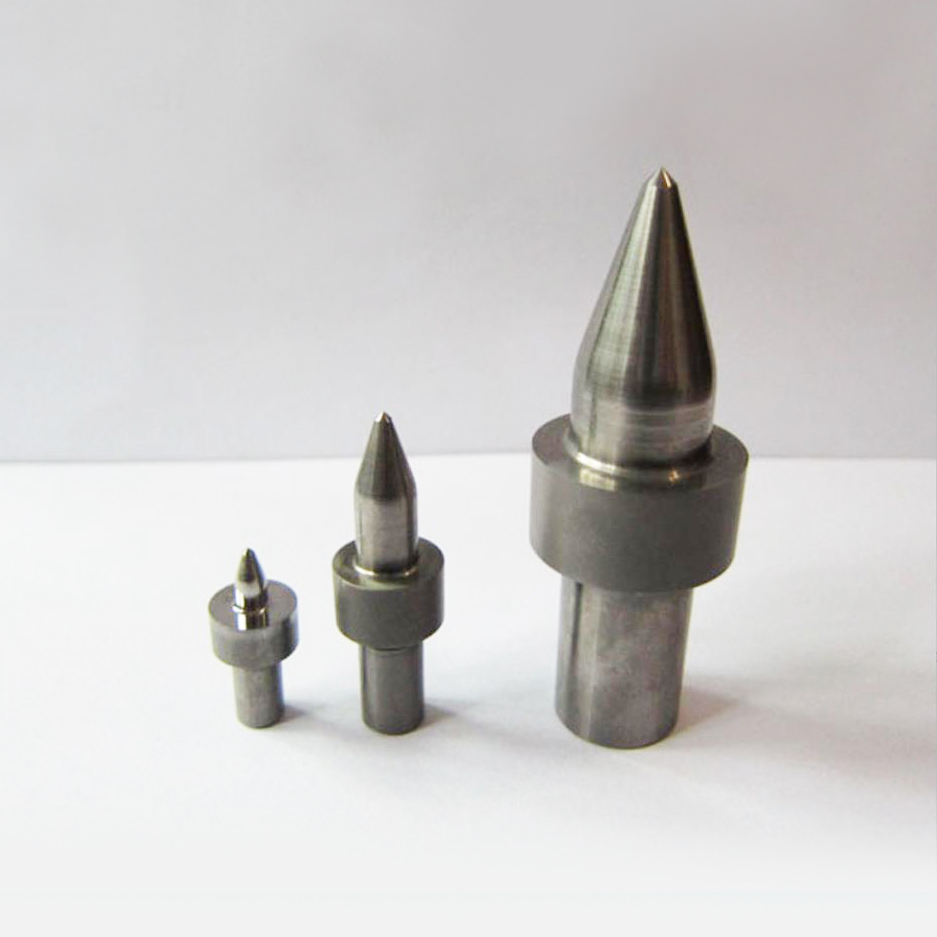
Friction drilling is a method of making holes in metal in which the material is pushed out of the way with the aid of heat from friction. The process is also called thermal drilling, flow drilling, form drilling, or friction stir drilling.The hot-melt drill bit is made of special hard alloy, which ensures the stability and service life of the drill bit at high temperature; the superb grinding technology ensures the high precision of the drill bit.Friction drilling is commonly used on bicycle frames, heat exchangers, and to create holes for mounting bearings.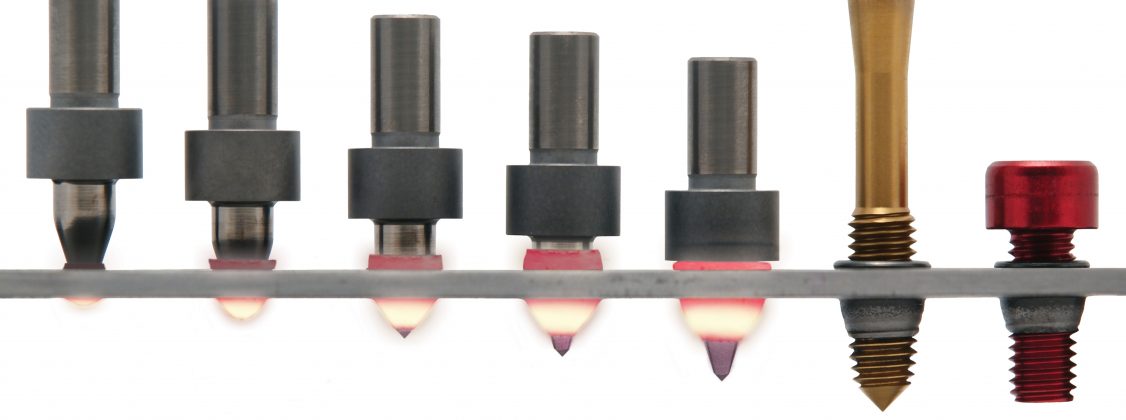
Advantages of Friction drilling
1.Very quick process (2 to 6 seconds).2.The process reshapes all material so that no material is lost. The excess material forms a sleeve that is about 3 times longer than the original thickness of the target material, which makes it possible to make very strong bolt joints in thin material.3.It is a clean process because no litter (particles) is produced.4.No access needed to back of workpiece, as with press-in or self-clinching hardware.5.More reliable and faster than rivet nuts (an alternative that also does not require access to back of workpiece).6.Works in almost all kinds of metal.including softer metal materials such as copper, brass, and aluminum alloys; they can also be applied to harder structural steel, high-grade steel, and high-strength special alloys. Classification of Friction drilling bits1.According to the surface requirements of the workpiece, hot-melt drills are divided into "standard hot-melt drills (round type)" and "flat hot-melt drills (flat type)":
2.According to the thickness of the workpiece, hot melt drills are divided into short drills and long drills:---Short drill: for commonly used thin-walled parts. It is suitable for penetrating workpieces with a thickness of 0.8mm -3mm. The cylindrical part of the drill bit is short, and the hole formed after extrusion is conical, which can enhance the tapping strength.---Long drill: For thicker workpieces, or when straight holes need to be machined. Suitable for penetrating workpiece thickness greater than 3mm -12mm. The cylindrical part of the drill bit is longer, and the hole formed by extrusion is longer.
Dimensions of Friction drilling bits
1. Standard tungsten carbide flowdrill bits are available in diameters from 2.0 mm to 25.4 mm.
2. The specifications and sizes of flowdrill bits are generally distinguished according to thread specifications. Common specifications include:
Metric coarse/fine thread (M): M3, M4, M5, M6, M8, M10, M12, M14, M16, M18, M20;
British straight pipe thread (BSP): G1/8, G1/4, G3/8, G1/2, G3/4;
American Coarse/Fine (UNC/UNF): No.4, No.5, No.6, No.8, No.10, No.12, 1/4, 5/16, 3/8, 7/ 16,1/2,9/16,5/8,3/4;
American tapered pipe thread (NPT): 1/8'', 1/4'', 3/8'', 1/2'', 3/4''.
3.Tungsten carbide flowdrill bits with special specifications can be customized according to the needs of users. Our technical team will design and produce hot-melt drills with special specifications according to the processing requirements; at the same time, we will also help in testing and analysis the performance.