When dealing with tolerances, we often meet situations where the tolerance is not unspecified. We have compiled key parameters from dimensional tolerances and geometric tolerances and provided detailed interpretations. GB/T 1804 is a Chinese national standard, equivalent to the international standard ISO 2768. These interpretations aim to make these standards more intuitive and understandable, and provide strong support for your work.1.Dimensional tolerance analysis
1.1 Basic Introduction to Dimensional Tolerances
When a drawing indicates "Unspecified dimensional tolerances shall be performed in accordance with ISO2768-m," it means that dimensions, chamfers, or angles for which tolerances are not explicitly specified on the drawing will follow the dimensional accuracy standards defined by the "m grade" in the following three tables. Linear dimensions refer to distance dimensions marked on the drawing, excluding holes, shafts, circles, arcs, and angles.
1.2 Chamfers and Fillets
On drawings, chamfers and fillets are two common linear dimensions. A chamfer is an angled angle formed at the edge of a workpiece with a certain radius, while a fillet transforms the edge of the workpiece into a rounded shape. Both of these dimensions are crucial for workpiece machining and design, but they can be difficult to understand when tolerance grades are not specified.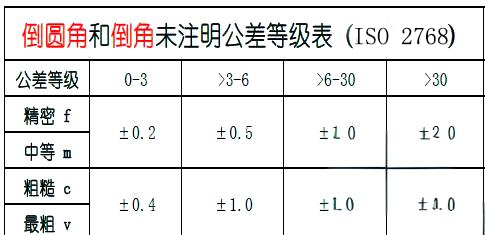
1.3 Angular Tolerance Handling
On drawings, when the tolerance grade of an angle is not explicitly specified, certain execution standards are usually followed. For example, if a drawing states "Unspecified dimensional tolerances shall be executed according to ISO 2768-m," this means that dimensions, chamfers, and angles without specified tolerances should be executed according to the "m-grade" dimensional accuracy standard. It is also worth noting that the national standard number for linear dimensions, chamfers and fillets, and angles is ISO 2768, and they all fall under the category of dimensional tolerances.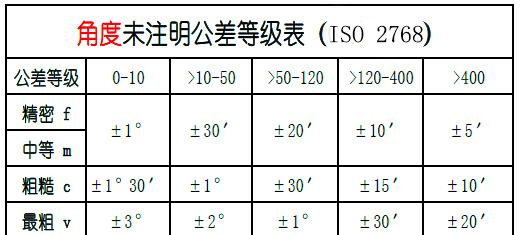
2. Geometric Tolerances Analysis
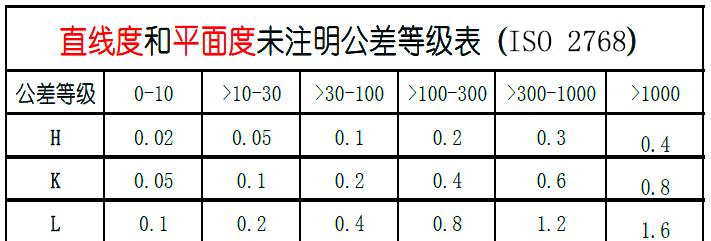
2.1. Straightness and Flatness
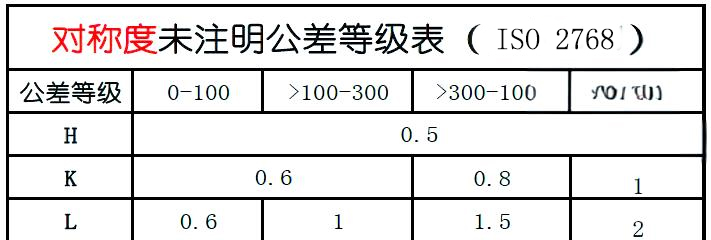
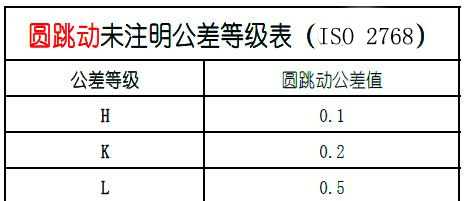
When a drawing specifies "Unspecified geometric tolerances shall be performed according to ISO 2768-K," it means that geometric tolerances such as straightness, flatness, perpendicularity, symmetry, and circular runout not explicitly indicated on the drawing will all comply with the dimensional accuracy requirements of "Grade K" in the ISO 2768 standard.
2.2. Symmetry and Circular Runout
In machining and drawing interpretation, symmetry is also a key geometric tolerance concept. However, when the tolerance grade for symmetry is not explicitly specified on the drawing, it is still necessary to refer to relevant standards to determine it. To facilitate understanding and implementation, we have compiled this table of unspecified symmetry tolerance grades, hoping to provide a practical reference for professionals in related fields.
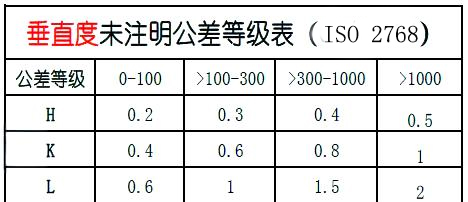
2.3. Perpendicularity
In machining and drawing interpretation, besides symmetry and circular runout, perpendicularity is also a key geometric tolerance indicator. When the tolerance grade for perpendicularity is not explicitly specified on the drawing, it is still necessary to refer to relevant standards to determine it.